
Understanding the Core Challenges in Mental Health Billing (Problem Area)
Mental and behavioral health billing is significantly more complex compared to other medical specialties. Providers often face multiple operational and compliance-related challenges that directly impact revenue cycle performance.
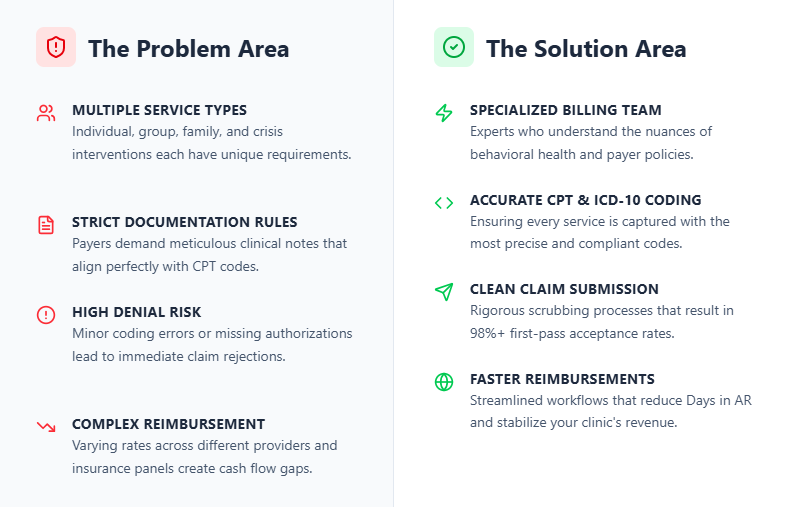
One of the biggest challenges is multiple service types. Mental health practices offer a wide range of services including individual therapy, group therapy, family counseling, and crisis interventions. Each service has unique billing requirements, CPT codes, and documentation standards, making the process highly detailed and error-prone.
Another critical issue is strict documentation requirements. Insurance payers require highly detailed and structured clinical notes that must align precisely with CPT codes. Even minor inconsistencies between documentation and coding can lead to claim rejections or audits.
Additionally, practices face a high denial risk. Small errors such as incorrect coding, missing prior authorizations, or incomplete documentation can result in immediate claim denials. This not only delays payments but also increases administrative workload.
Lastly, complex reimbursement structures create further challenges. Payment rates can vary widely across insurance providers and plans, often leading to unpredictable cash flow and revenue gaps for clinics.
How Specialized Billing Solutions Solve These Challenges (Solution Area)
To overcome these challenges, healthcare providers need a strategic and specialized approach to revenue cycle management.
A specialized billing team plays a crucial role by understanding the unique requirements of behavioral health services and payer-specific guidelines. Their expertise ensures that claims are processed accurately from the start.
Accurate CPT and ICD-10 coding is essential for successful billing. By ensuring that every service is coded correctly and in compliance with regulations, practices can significantly reduce errors and improve claim acceptance rates.
Another key factor is clean claim submission. Through rigorous claim scrubbing and validation processes, billing teams can achieve higher first-pass acceptance rates, minimizing rework and delays.
Finally, faster reimbursements are achieved through streamlined workflows and proactive follow-ups. This reduces Days in Accounts Receivable (AR) and ensures a steady and predictable revenue stream for the practice.