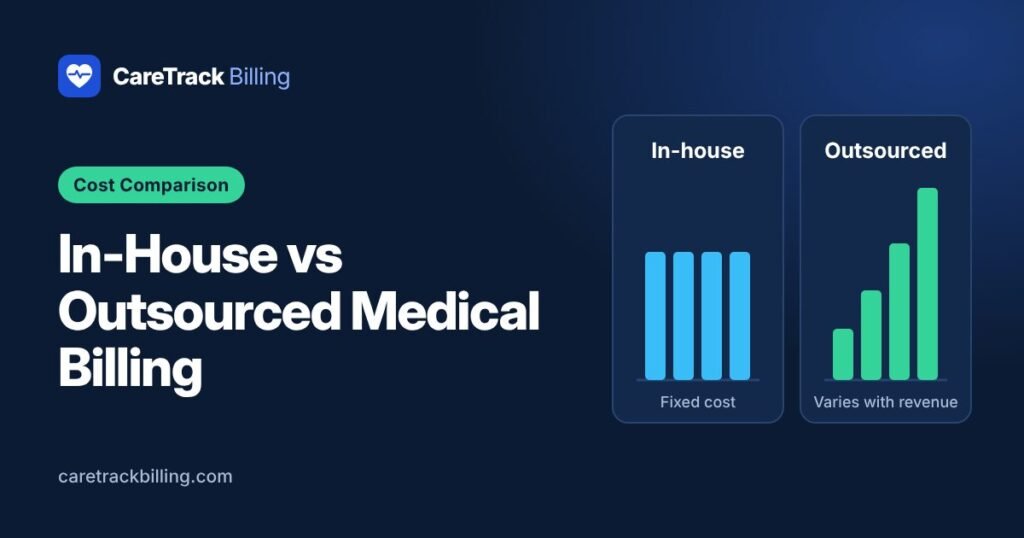
In-house medical billing is mostly a fixed cost, while outsourced billing usually rises and falls with your collections. Outsourcing often costs less for smaller practices. In-house billing can become cheaper at higher volume, but only if your team keeps denials and A/R under control.
This guide shows how to compare the full cost of each option, with a worked example and a calculator you can use with your own numbers.
In-House vs Outsourced Billing at a Glance
| Factor | In-house billing | Outsourced billing |
|---|---|---|
| Cost structure | Mostly fixed | Often a percentage of collections |
| Main costs | Salary, benefits, software and training | Service fee and any extra charges |
| Staff cover | You arrange it | Handled by the billing team |
| Control | Direct daily oversight | Managed through reports and agreed processes |
| Hiring and training | Your responsibility | The billing company’s responsibility |
What In-House Billing Really Costs
Salary is only the starting point. Add up each of these:
- Pay: The U.S. Bureau of Labor Statistics reports a median annual wage of $51,140 for medical records specialists as of May 2025. This is a related category, not an exact match for every biller, and pay varies by location and experience.
- Benefits: In June 2026, benefits made up 30% of total compensation for private industry workers. Your own cost may be higher or lower.
- Software: Include billing software, clearinghouse and other tool fees.
- Training: Coding, payer and compliance updates all take time and money.
- Cover: Plan for vacation, sick days and turnover.
- Management: Count the time you or your office manager spend supervising billing.
What Outsourced Billing Really Costs
Outsourced billing is often priced as a percentage of collections, but check the total cost in the contract. Ask about setup fees, monthly minimums, credentialing, statements and exit fees. Our guide to what medical billing services cost explains each pricing model.
Compare the Cost for Your Practice
Enter your own staffing and collections numbers to compare the yearly cost of each option.
Example: One Biller vs a 6% Fee
This example assumes one in-house biller paid $51,140 a year, benefits and overhead of 30% on top of salary, and $6,000 a year for software. These are example assumptions, so replace them with your own figures.
| In-house cost | Per year |
|---|---|
| Salary | $51,140 |
| Benefits and overhead at 30% | $15,342 |
| Software and clearinghouse | $6,000 |
| Total | $72,482 |
Now compare that with a 6% outsourced fee at three practice sizes:
| Monthly collections | Outsourced cost per year | In-house cost per year | Lower cost |
|---|---|---|---|
| $20,000 | $14,400 | $72,482 | Outsourced |
| $40,000 | $28,800 | $72,482 | Outsourced |
| $100,000 | $72,000 | $72,482 | About the same |
This compares cost only. It does not include revenue gained or lost through denials, A/R follow-up or staff cover.
How to Find Your Break-Even Point
Divide your yearly in-house cost by the outsourced fee percentage. The answer is the yearly collections at which both options cost about the same.
Example: $72,482 divided by 6% is about $1,208,000 in yearly collections, or roughly $100,700 a month.
Below that level, outsourcing costs less in this example. Above it, one in-house biller costs less, but that assumes one person can handle the full workload.
Do Not Compare Cost Alone
The cheaper option on paper can cost more if claims are left unpaid. Before you decide, review:
- Denials: Are denials tracked by reason and worked quickly?
- Days in A/R: Is it rising or stable?
- Net collection rate: Are you collecting what you should?
- Claim lag: How long do charges sit before claims go out?
- Single-person risk: What happens if your biller leaves?
When In-House Billing Makes Sense
- You have a trained biller and backup cover
- Your denial and collection numbers are healthy
- Your volume justifies a dedicated role
- You want direct daily control of the work
When Outsourcing Makes Sense
- Your collections are too low to justify a full-time biller
- Denials and aged A/R keep growing
- You rely on one person for billing
- Clinicians or front desk staff are doing billing work
- You need better reporting
You can also start small by outsourcing one part of the work, such as denial follow-up or A/R cleanup. Therapy practices can read our guide to whether therapists should outsource billing.
Frequently Asked Questions
Is outsourcing medical billing cheaper than hiring a biller?
It often is for smaller practices, because you avoid a full-time salary. At higher collections, an in-house team can cost less. Use your own numbers to compare.
What is the biggest hidden cost of in-house billing?
It is often work that does not get done, such as unworked denials and aging A/R. Staff turnover and cover can also be costly.
Will I lose control if I outsource?
You should not. Ask for regular reports, a named contact and clear approval rules for write-offs and patient balances.
Can I outsource only part of my billing?
Many companies offer partial services. Ask which tasks can be separated and how they are priced.
Get a Second Opinion on Your Numbers
Not sure which option fits your practice? Request a free billing audit and we will review your claims, denials and A/R. You can also explore our medical billing services.