Psychotherapy codes look simple, but small mistakes with time, add-ons and modifiers are one of the most common reasons mental health claims get denied or underpaid. This guide covers the psychotherapy CPT codes therapists and psychiatric practices use most, the time rules behind them and the errors that cost practices money.
At a Glance
- Individual psychotherapy is billed by time: 90832 (16–37 min), 90834 (38–52 min) and 90837 (53+ min).
- Intake visits use 90791 (no medical services) or 90792 (with medical services).
- Prescribers who do therapy in the same visit as an E/M service bill add-ons +90833, +90836 or +90838.
- Most denials come from missing start and stop times, wrong time ranges, missed authorizations and incorrect telehealth modifiers.
Diagnostic Evaluation Codes: 90791 and 90792
90791 is a psychiatric diagnostic evaluation without medical services. It is used by psychologists, LCSWs, LPCs, LMFTs and other licensed therapists for the first assessment visit.
90792 is a psychiatric diagnostic evaluation with medical services, such as a medication review or physical exam elements. It can only be billed by prescribers: psychiatrists, psychiatric nurse practitioners and physician assistants.
Neither code is time-based, but the note must show a full assessment: history, mental status, diagnosis and a treatment plan. Many payers limit these codes to one per patient per provider in a set period unless the patient’s condition changes, so check each payer’s frequency rule before billing a second evaluation.
Individual Psychotherapy: 90832, 90834 and 90837
These are stand-alone, time-based codes. Time means face-to-face time spent with the patient and/or family member doing psychotherapy. Pick the code based on the actual time documented, not the scheduled appointment length.
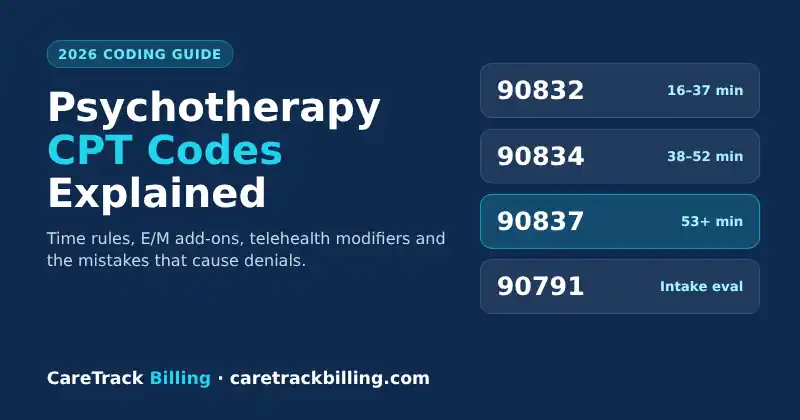
| CPT Code | Description | Time Range |
|---|---|---|
| 90832 | Psychotherapy, 30 minutes | 16–37 minutes |
| 90834 | Psychotherapy, 45 minutes | 38–52 minutes |
| 90837 | Psychotherapy, 60 minutes | 53 minutes or more |
A session under 16 minutes cannot be billed as psychotherapy. A 50-minute session is a 90834, not a 90837, even if the appointment was booked as a “60-minute hour.”
About 90837: it pays more than 90834, which is why some payers review it closely. Bill it when the session truly lasted 53 minutes or more, and make sure the note explains why the longer session was clinically needed. Some commercial payers and plans managed by behavioral health carve-outs also require prior authorization or limit how often 90837 can be billed.
Psychotherapy With E/M: +90833, +90836 and +90838
When a psychiatrist or psychiatric NP manages medication and provides therapy in the same visit, they bill an E/M code (99202–99205 for new patients, 99212–99215 for established patients) plus a psychotherapy add-on code.
| Add-on Code | Description | Time Range |
|---|---|---|
| +90833 | Psychotherapy with E/M, 30 minutes | 16–37 minutes |
| +90836 | Psychotherapy with E/M, 45 minutes | 38–52 minutes |
| +90838 | Psychotherapy with E/M, 60 minutes | 53 minutes or more |
The key rule: the E/M and the psychotherapy must be separately identifiable. Time spent on the E/M (medication review, side effects, prescribing) cannot be counted toward the psychotherapy time. If you pick the E/M level based on time, you cannot use the same minutes twice. Document each part clearly in the note.
Family, Group and Crisis Codes
- 90846: Family psychotherapy without the patient present (50 minutes).
- 90847: Family psychotherapy with the patient present (50 minutes).
- 90849: Multiple-family group psychotherapy.
- 90853: Group psychotherapy (not family). Billed once per patient in the group.
- 90839: Psychotherapy for crisis, first 60 minutes (used for 30–74 minutes).
- +90840: Each additional 30 minutes of crisis psychotherapy, added to 90839.
Crisis codes need documentation of an urgent assessment, mental status, and the steps taken to reduce the crisis. They should not be billed with 90791, 90792 or the regular psychotherapy codes on the same day.
Interactive Complexity: +90785
+90785 is an add-on for sessions where communication factors make the work harder, for example a caregiver whose behavior interferes with treatment, a child who needs play equipment to communicate, or a need to report a sentinel event to a third party.
It can be added to 90791, 90792, 90832–90838 and 90853. It cannot be billed with crisis codes (90839/90840) or with family therapy codes (90846/90847), and an interpreter or translator alone does not qualify. The note has to say exactly what made the session complex.
Telehealth Billing for Psychotherapy
The same CPT codes are used for telehealth sessions. What changes is the place of service (POS) and modifier:
- POS 10 when the patient is at home, and POS 02 when the patient is somewhere other than home.
- Modifier 95 for real-time audio-video sessions, where the payer asks for it.
- Modifier 93 for audio-only sessions, where the payer allows them.
Medicare and commercial payers do not all follow the same rules, and they change often. Check each payer’s current telehealth policy, and review our guide to telehealth mental health billing mistakes.
Common Psychotherapy Coding Mistakes
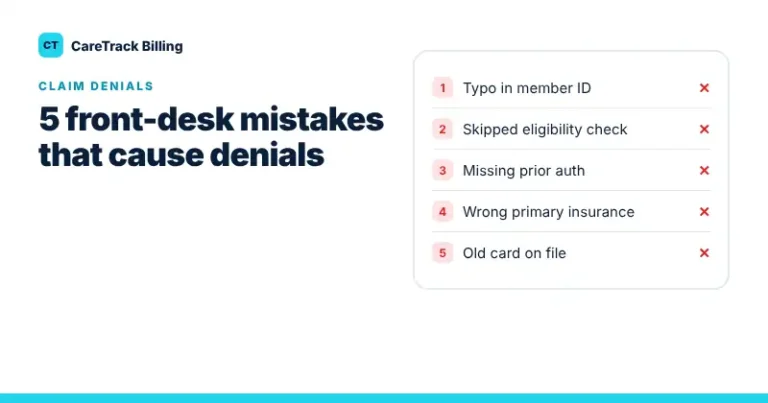
- No start and stop times. Many payers deny or recoup time-based claims without them.
- Billing by appointment length. A 50-minute “hour” is a 90834, not a 90837.
- Double-counting time between an E/M and a psychotherapy add-on.
- Missed prior authorization or exceeded session limits, especially with carve-out payers.
- Wrong POS or modifier on telehealth claims.
- Using +90785 without the reason documented, or with codes it cannot be paired with.
- Billing 90792 as a non-prescriber. Therapists without prescribing authority should use 90791.
If these issues sound familiar, see our guide on how to reduce mental health claim denials.
Frequently Asked Questions
What is the difference between 90834 and 90837?
Time. 90834 covers 38–52 minutes of psychotherapy, and 90837 covers 53 minutes or more. 90837 pays more, so the documented time and clinical reason must support it.
Can a therapist bill 90792?
No. 90792 includes medical services, so it is for prescribers such as psychiatrists and psychiatric nurse practitioners. Therapists use 90791 for intake evaluations.
Can I bill 90837 every week?
CPT does not limit it, but many payers watch for frequent 90837 use and some require authorization. Make sure each note shows the time and why the longer session was needed.
Do telehealth sessions use different CPT codes?
No. Telehealth psychotherapy uses the same codes. The place of service and modifier change based on where the patient is and each payer’s rules.
Get Your Psychotherapy Claims Reviewed
CareTrack Billing helps US mental health and psychiatry practices code psychotherapy correctly, track authorizations and follow up on every denial. Not sure if your codes are costing you money? Request a free billing audit and we will review your claims, denials and A/R, or contact our team.
CPT® is a registered trademark of the American Medical Association. This article is for general information. Payer rules vary, so always check current payer policies and CPT guidance.